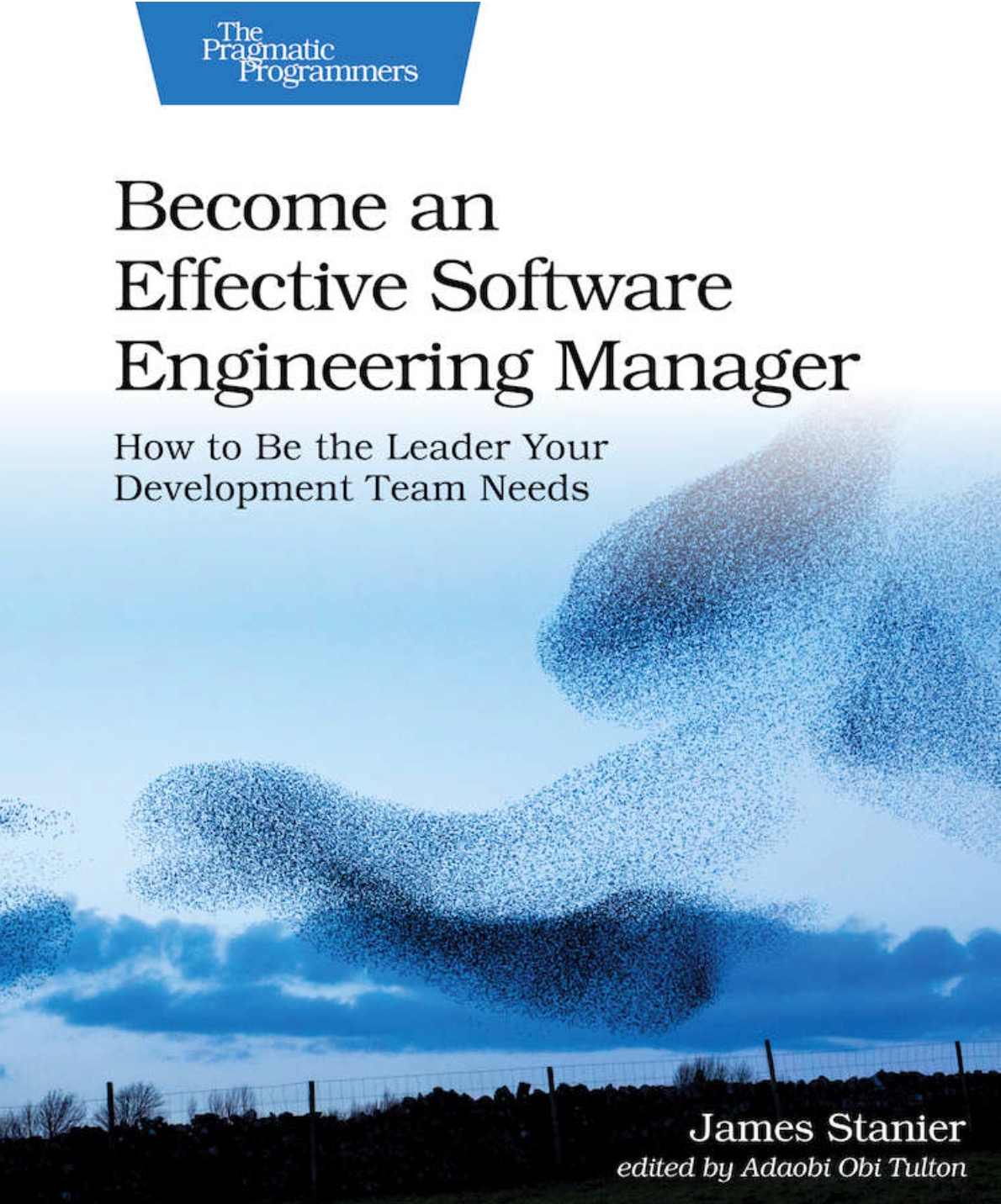
Become an Effective Software Engineering Manager
📅 Finished on: 2025-11-09
💼 Work
⭐⭐⭐⭐⭐
your output + your team's output = result. This changes now.
Suggested here, it is on the Pragmatic Programmer list; I read the others and they are good, the rest remains to do. This one won me over mostly with the chapter list. Let’s see, since it may be useful for the new journey. Review
Excellent book, practical, full of common sense. I almost gave it 5 stars; a few chapters did not fully hold my interest. It summarizes all the steps a new manager needs, from getting settled to the first steps to the toughest moments. A solid guide.
Notes
- If it scares you, it might be a good thing to try. - Seth Godin
- Make a strict rule for your to-do list: if something is not on it, you do not do it. It helps you stay organized. Your to-do list is the only place where your tasks live.
- A good manager leads by example. Be present and visible, involved, and contribute.
- 🔑 Equation: your output + your team’s output = result.
- How to give feedback? Radical candor: care about the person you are evaluating, and be honest and direct.
- Intro recap:
- We have explored the different mediums of communication—spoken, written, and nonverbal—and how you should use them to best suit the message you are delivering.
- You should be mindful of your mood and energy when going from activity to activity, and you should only communicate when you need to, not when you have the urge to.
- We have seen that communication is not about you. It is about the recipients. You should ensure that you listen, have two-way conversations, and respect people’s preferences for interactions.
- Consistency is important for your own voice across spoken, written, and nonverbal communication. You should be aware of the weight your voice has as a manager and be a role model for those you interact with.
- Delegate. You cannot be an effective manager if you do not trust the group. Win-win: your team feels more useful, and you carry less weight. Do not abdicate; keep accountability. Do not take the task back once you have assigned it; trust your teammate.
- Create a weekly recap to share with your manager. Align with them so they are up to date on news, ideas, and status before the 1-1. What are you working on? What’s on their mind? What did you discover that was interesting to you? Schedule a weekly summary to your manager. Begin the habit by starting on it this week. How did you feel doing it? Did it help you pause and reflect on what you have been doing? Be proactive.
- Communication recap:
- How to communicate well through spoken, written, and nonverbal communication.
- A framework for delegation, which may be one of the most important things that you learn as a new manager. Many managers either don’t delegate properly or do it badly, so you can have a real head start if you begin practicing this.
- How to define the relationship with your own manager by pulling on them rather than waiting for them to push to you, keeping your performance as part of regular conversation, and encouraging them to share more about what they are doing with you so you can…
- 🔑 Absorb information and guide. Your reports should do 70% of the talking. Let them reach the conclusion on their own.
- 1-1 tip: have a shared agenda to review before the meeting.
- Humans have certain needs, and after money and food there is feeling fulfilled. These are psychological needs.
- Remember that in the review process you, as a manager, are the facilitator. You are not the dictator. Deliver a stellar service to your staff, not a judgment.
- Performance review recap:
- We looked at some common misconceptions and myths around performance reviews and showed why they are wrong.
- You learned how to prepare for your reviews and how to track all of the preparatory tasks through a tracker document.
- Then we looked at the written review and how to create your own review forms that both you and your staff contribute to.
- Hiring: you need to find the right person, not just add engineers or hire only seniors.
- Identify the bottleneck and look for the right person to solve it. QA? Innovation? DevOps? You need that skill.
- Hiring recap:
- How to work out who to hire into your team. You considered your team, their output, and then worked out who best would increase it.
- How to write job descriptions. Not only did you learn how to put them together, you also understood how job descriptions can encode bias and unintentionally discriminate against candidates.
- How to run an interview process. From phone screens to the final interview, you have been through it and can replicate the same thing in your own company.
- Departures recap:
- That people will always leave. You should now know that it is perfectly normal and there is often little you can do about it. Natural turnover, however, can be advantageous in bringing new, diverse ideas to your team.
- How to know when people should go with your blessing. You learned about the good reasons that people may leave and how to accept it, be grateful that you got to work with them, and send them on their way with a smile.
- How to fight for staff to stay. You considered when it is appropriate to try your best to keep staff from leaving, what mechanisms you can use to do so, and the trade-offs you will face.
- How to make people leave. You then learned about Performance Improvement Plans: when to use them, how to write them, and what to do during the process. Remember that despite the difficulty, they are a win-win situation for you: either a poor performer improves or they leave and you get to replace them with someone else.
- Go beyond your team; having contacts across the company helps move everyone forward.
- Influence others: do not tell them what to do; nudge them in the right direction. For example: “this problem reminds me of what XXX saw; have you thought about asking them?”
- Influence recap:
- Why considering the world beyond your team matters. We revisited our favorite output equation and saw how building your network and assisting others outside your team can positively affect your output as a manager.
- How to build your network inside the company. You learned about how the snow melts at the periphery, and how to build your network so that your metaphorical eyes and ears can see and hear better to help yourself and your team.
- How to give back to others through mentoring and coaching. Finally, you learned about mentoring and coaching, and have the tools to mentor and coach others and find mentorship and coaching for yourself.
- You will have bad news. Do not stall; communicate it immediately and honestly.
- Often the point of “they are not working enough” is the result of a communication mismatch. Visible output is very important. Or it may be a lack of passion, to be assessed.
- Whip and carrot. Better: autonomy, mastery, and purpose.
- Your ability to deal with bad situations is your true test as a manager. And there will be plenty of bad situations.
- Challenge recap:
- That you will face scrutiny and judgment, and you will feel it toward others as well. That bad situations create wobble, and that the higher up in the org chart they occur, the worse the effects on everyone else.
- That others may want you to apply the whip to make your team work harder and faster; however, you need to reframe that into the carrot that makes your team autonomously drive themselves forward.
- That we are all subject to the Dunning-Kruger effect.
- 🔑 Always show progress. Always expose the hidden complexity.
- The larger the company gets, the more productivity per person tends to drop. Optimizing and being pragmatic is critical.
- Features go into must, should, could, and won’t.
- 🔑 Always remember:
- The Hippocratic Oath: an oath of ethics historically taken by doctors, shortened here to the following succinct phrase: first, do no harm.
- The Golden Rule: an ethic that is the basis of a number of religions and cultures: treat others as you would like to be treated yourself.
- Secrets: be consistent, share only what is relevant to others and what they have reason to know. 🔑 Without information, people panic. But no gossip.
- You need to be a gatekeeper, rather than a spy.
- Final delegation recap:
- How to let go of tasks. Being an effective manager is all about letting go via delegation to improve and empower your teams.
- However, we also looked at how even though you may be delegating well, you might still be worrying. We took some inspiration from the Stoics to reframe how we think about things that we control, things that we do not control, and things that we have some control over.
- We learned how to set internal rather than external goals to not set ourselves up for failure.
- Work on yourself recap:
- How to let go of your preconceptions for effective work. We explored the L-mode and R-mode of your brain, and how not carving out time for yourself at work may be seriously hampering your creativity.
- We also saw how setting aside this time can make you a more effective manager by giving you flex to react to emergencies, interruptions, and people who need you. How to let go of work after work.
- We learned some simple techniques for improving your body and mind. You saw the importance of sleep, exercise, and mindfulness as tools to make you a better manager and human being.
- Use guilds to fight silos; tribal knowledge is very important.
- Progression recap:
- We defined the role of individual contributor and considered what progression looks like on that track.
- Then we considered progression on the management track. Using the example progressions from those tracks, we saw how you can define competencies that can be mapped against roles. This allows you to create a career progression framework that is adaptable to your team and department.
- We then looked at some common bugs that arise around career progression frameworks and what you can do about them.
- Inclusivity recap:
- We saw that having a compelling vision for the future, backed up by a short-term actionable plan, is a key ingredient for the success and happiness of you and your staff.
- We went through a multistage exercise in which you were able to create these for yourself, culminating in a skills backlog that you can continually work on.