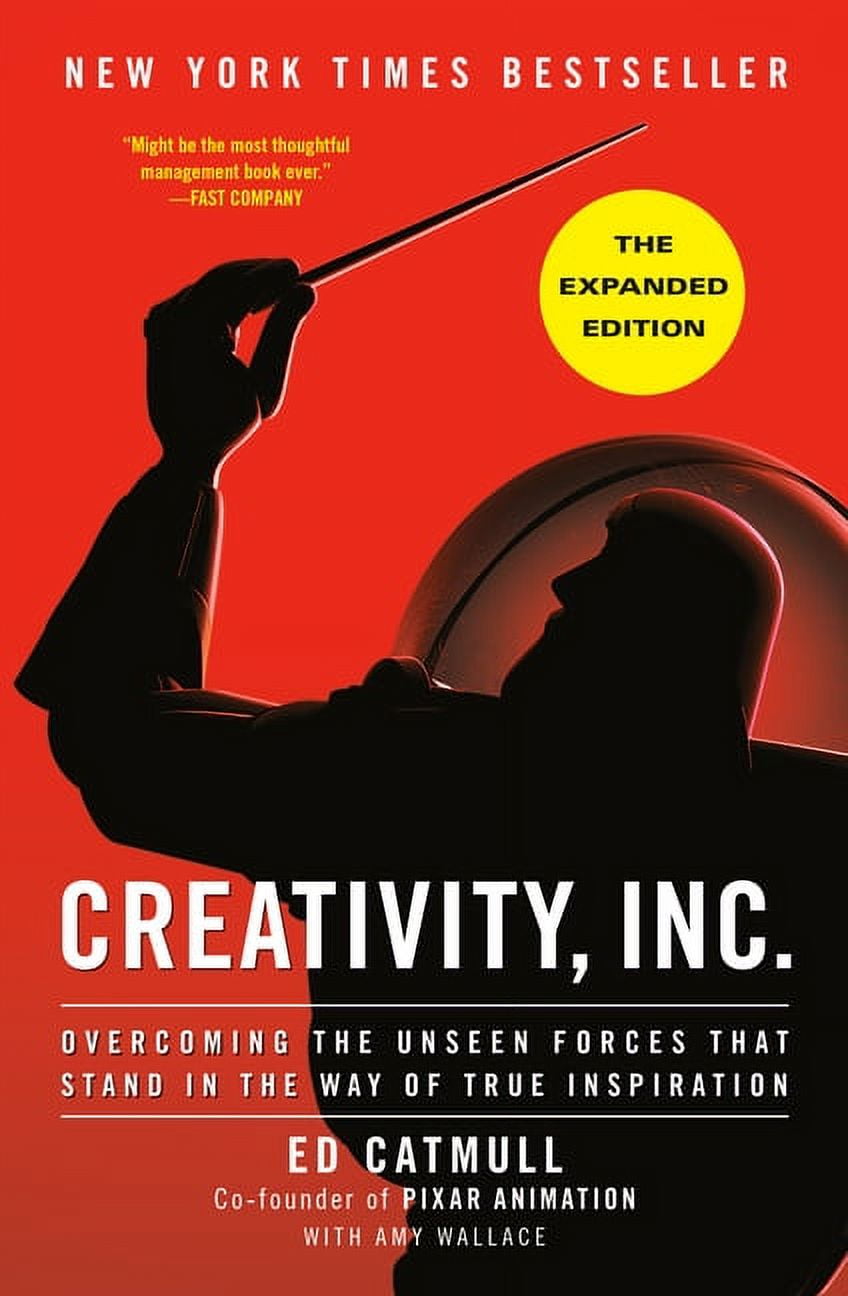
Creativity, Inc.
📅 Finished on: 2025-12-30
🧘♀️ Lifestyle
💼 Work
⭐⭐⭐⭐⭐
Change is going to happen, whether we like it or not.
Recommended by Tim Ferriss in Tools of Titans along with many other books. I like Pixar’s story; it could be a good thing to bring into the company. It is a book about creativity.
Very inspiring. Ed tells very well the early years of Pixar, his story, his life, and his vision. What truly sparks creativity, and the difficulties when no one believed in them, when they merged with Disney, film failures and experiments, and much more, from the leader’s point of view. Beautiful, a must-have for a manager.
Notes
- Pixar always had one aim: make a great film
- As a principle, Ed always wanted not only to build a successful company, but also a culture of sustainable creativity
- Example: the rectangular table; they sat in a kind of hierarchical order that blocked the flow of ideas. No one said it, they did not notice. They immediately changed the table, because at Pixar anyone can give voice to ideas
- Disney’s problem: they were stuck in a dark period; ideas were blocked by fear of failure. Ed then tried his luck at LucasArts, and later founded Pixar, as scary as the idea of producing a fully digital film was
- They always shared their progress, like a mechanism to speed up animation, without hiding knowledge that would slow progress
- The biggest problem is human resistance to change
- | For all the care you put into artistry, visual polish frequently
- If the story is that good, no one (or rather, few) will notice small technical flaws (see their first incomplete short)
- Steve Jobs is a fascinating figure. Very hard to work with, but he carried Pixar forward with heart. There is a wonderful section dedicated to him toward the end.
- In general he attacks your ideas aggressively, and you have to defend yourself until he understands you are right or you give in
- Story Is King → first principle of Pixar
- Choose the right team to get the right ideas; they must interact with each other
- Candor is crucial; no one should fear saying the wrong thing. Pixar has a system of Braintrust meetings where people gather and “challenge” the producer to see where there are problems in the story, objectively and impartially. Fundamental for evaluating ideas
- Avoid cultures where fear of failure is promoted, and especially the hunt for someone to blame
- The director, or leader, can never lose the confidence of his or her crew. Show that you are in command. If you appear lost, the team will notice and will be truly afraid
- There will always be errors. Hire the best people, give them responsibility, let them break things and fix them
- Chapter on the merger with Disney, sadly necessary and fascinating in how they kept entities separate while they “revived” Disney
- Change is going to happen, whether we like it or not. Let’s not try to predict the future, but changes are part of life and we will never have certainties. Do not fear them; make choices to examine them and benefit from them
- At times there will be major events, but we have a bias to consider them in two categories distinct from the “normal” ones. Wrong, treat everything as an unexpected problem
- Face small and large problems with the same set of values and emotions, do not panic. Accept that we cannot manage every facet of a complex system
- Pixar in fact came very close several times to not existing or failing
- Acknowledge the unseen. There are a lot of “two inches events” that could happen or could have happened that bring us to where we are
- Practical analysis of the practices that led Pixar to be what it is:
- Dailies, or Solving Problems Together
- Research Trips → very useful for immersive understanding
- The Power of Limits → do not think about how to avoid problems, but about how - get people to solve them
- Integrating Technology and Art
- Short Experiments
- Learning to See
- Postmortems → list 5 things they liked, 5 things they would not want to do again
- Notes Day: a great event where everyone proposed ideas to the various technical, cultural, and spiritual problems Pixar was having, and they did a huge brainstorming together. Brilliant idea
- Good producers - and good managers - don’t dictate from on high. They reach out, they listen, they wrangle, coax, and cajole.
- A good speech at Steve’s passing:
- “I remember twenty-five years ago in February, the day that Pixar was formed,” I began, recalling how we gathered in a conference room at Lucasfilm to sign the papers transferring majority ownership to Steve. We were exhausted, having spent months looking for potential suitors before Steve stepped forward. For those who weren’t at Pixar in the beginning, I recalled how Steve had pulled Alvy Ray Smith and me aside, put his arms around us, and said, “As we’re going through this, there’s one thing I dearly ask. And that is that we be loyal to each other.”
- 🔑 Ed’s final recap:
- Give a good idea to a mediocre team, and they will screw it up. Give a mediocre idea to a great team, and they will either fix it or come up with something better. If you get the team right, chances are that they’ll get the ideas right.
- When looking to hire people, give their potential to grow more weight than their current skill level. What they will be capable of tomorrow is more important than what they can do today.
- Always try to hire people who are smarter than you. Always take a chance on better, even if it seems like a potential threat.
- If there are people in your organization who feel they are not free to suggest ideas, you lose. Do not discount ideas from unexpected sources. Inspiration can, and does, come from anywhere.
- It isn’t enough merely to be open to ideas from others. Engaging the collective brainpower of the people you work with is an active, ongoing process. As a manager, you must coax ideas out of your staff and constantly push them to contribute.
- There are many valid reasons why people aren’t candid with one another in a work environment. Your job is to search for those reasons and then address them.
- Likewise, if someone disagrees with you, there is a reason. Our first job is to understand the reasoning behind their conclusions.
- Further, if there is fear in an organization, there is a reason for it - our job is (a) to find what’s causing it, (b) to understand it, and (c) to try to root it out.
- There is nothing quite as effective, when it comes to shutting down alternative viewpoints, as being convinced you are right.
- In general, people are hesitant to say things that might rock the boat. Braintrust meetings, dailies, postmortems, and Notes Day are all efforts to reinforce the idea that it is okay to express yourself. All are mechanisms of self-assessment that seek to uncover what’s real.
- If there is more truth in the hallways than in meetings, you have a problem.
- Many managers feel that if they are not notified about problems before others are or if they are surprised in a meeting, then that is a sign of disrespect. Get over it.
- Careful “messaging” to downplay problems makes you appear to be lying, deluded, ignorant, or uncaring. Sharing problems is an act of inclusion that makes employees feel invested in the larger enterprise.
- The first conclusions we draw from our successes and failures are typically wrong. Measuring the outcome without evaluating the process is deceiving.
- Do not fall for the illusion that by preventing errors, you won’t have errors to fix. The truth is, the cost of preventing errors is often far greater than the cost of fixing them.
- Change and uncertainty are part of life. Our job is not to resist them but to build the capability to recover when unexpected events occur. If you don’t always try to uncover what is unseen and understand its nature, you will be ill prepared to lead.
- Similarly, it is not the manager’s job to prevent risks. It is the manager’s job to make it safe to take them. Failure isn’t a necessary evil. In fact, it isn’t evil at all. It is a necessary consequence of doing something new.
- Trust doesn’t mean that you trust that someone won’t screw up - it means you trust them even when they do screw up.
- The people ultimately responsible for implementing a plan must be empowered to make decisions when things go wrong, even before getting approval. Finding and fixing problems is everybody’s job. Anyone should be able to stop the production line.
- The desire for everything to run smoothly is a false goal - it leads to measuring people by the mistakes they make rather than by their ability to solve problems.
- Don’t wait for things to be perfect before you share them with others. Show early and show often. It’ll be pretty when we get there, but it won’t be pretty along the way. And that’s as it should be. A company’s communication structure should not mirror its organizational structure. Everybody should be able to talk to anybody.
- Be wary of making too many rules. Rules can simplify life for managers, but they can be demeaning to the 95 percent who behave well. Don’t create rules to rein in the other 5 percent - address abuses of common sense individually. This is more work but ultimately healthier.
- Imposing limits can encourage a creative response. Excellent work can emerge from uncomfortable or seemingly untenable circumstances.
- Engaging with exceptionally hard problems forces us to think differently.
- An organization, as a whole, is more conservative and resistant to change than the individuals who comprise it. Do not assume that general agreement will lead to change - it takes substantial energy to move a group, even when all are on board.
- The healthiest organizations are made up of departments whose agendas differ but whose goals are interdependent. If one agenda wins, we all lose.
- Our job as managers in creative environments is to protect new ideas from those who don’t understand that in order for greatness to emerge, there must be phases of not-so-greatness. Protect the future, not the past.
- New crises are not always lamentable - they test and demonstrate a company’s values. The process of problem-solving often bonds people together and keeps the culture in the present.
- Excellence, quality, and good should be earned words, attributed by others to us, not proclaimed by us about ourselves.
- Do not accidentally make stability a goal. Balance is more important than stability. Don’t confuse the process with the goal. Working on our processes to make them better, easier, and more efficient is an indispensable activity and something we should continually work on - but it is not the goal. Making the product great is the goal.
- For Steve