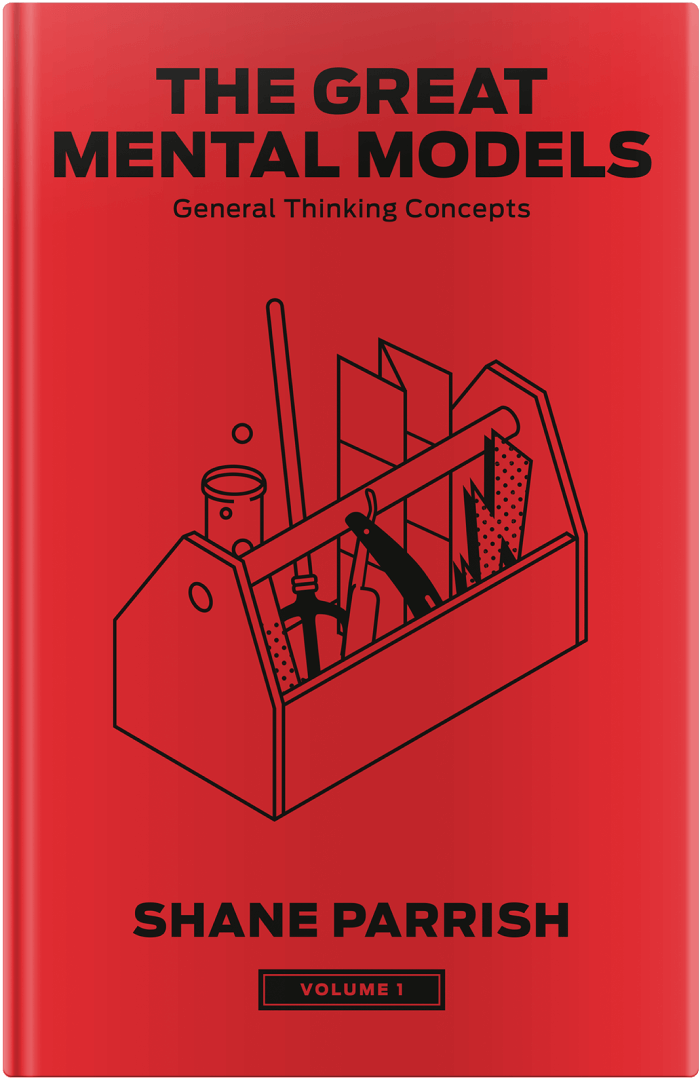
The Great Mental Models
📅 Finished on: 2022-10-23
🧘♀️ Lifestyle
⭐️⭐️⭐️
You can't really know everything; you can, however, use simpler models that will help you avoid the most common mistakes
Book from the Farnam Street blog on productivity, recommended by Marcello Ascani. It is the whole blog condensed into a book. Nice, very simple and clear; it helped me review concepts I already knew. About half the book felt a bit basic, but it reads quickly, and I appreciated the two razors. I am considering the second book.
Notes
Using mental models every day helps in making better decisions. I do not assume I will get everything perfect; I simply want something that works in the general case. Here are 9 models from the book:
- The Map Is Not The Territory: a simplification of reality is not reality itself, otherwise it would not be a map. Keep the map updated and free of bias, and remember you will ultimately have to deal with reality.
- Circle of Competence: stay within your areas. Be honest about your skills and use the fields where you are most experienced as your main resource, knowing when to ask for help or outsource in areas where you are not competent.
- First Principles Thinking: separate the idea from any assumptions, using a Socratic approach. Simplify the process. Example: the scientific discovery of bacteria in the stomach; no one thought they could be there, so that assumption had to be challenged.
- Thought Experiment: imagine the scenario in your head and run simulations.
- Second-Order Thinking: look at the long-term consequences of your choices, not just the immediate ones.
- Probabilistic Thinking: Bayesian thinking; try to infer what you know from an end result. Also, asymmetries: people often build models that extreme events destroy (black swans). Be careful.
- Inversion: think in reverse. Instead of a goal, aim to avoid something. Instead of trying to prove something is true, try to show that something else is true (Sherlock Holmes).
- Occam’s Razor: the simplest solution is usually the correct one. A good example from probabilities: if a solution requires many variables to align, it is statistically unlikely.
- Hanlon’s Razor: give the benefit of the doubt. If someone cuts you off, why assume it is on purpose? It is more likely carelessness or self-interest. Do not attribute to malice what is better explained by human error.