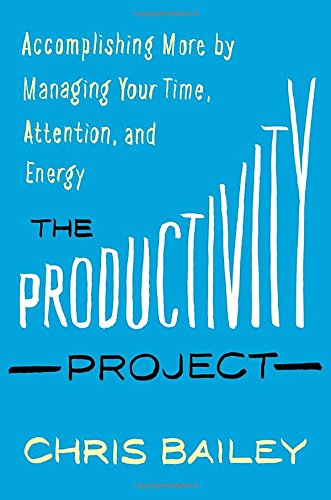
The Productivity Project
📅 Finished on: 2022-09-26
🧘♀️ Lifestyle
💼 Work
⭐⭐⭐⭐
Focus on tasks that have a big impact on your work. Meditate. Reduce caffeine and distractions. Three tasks a day. Limit procrastination
Recommended by Thomas Frank for productivity. General overview, with a focus on how to avoid procrastination. All in all a good book; the author is clearly passionate about the topic and spent a year testing different techniques.
I have read comments that the author has never had a job and that many tips are obvious or unrealistic, but this book convinced me about meditation, about caffeine, about how optimizing time without distractions is very effective, and it summarizes many other books I have read. Very interesting in my view.
Notes
- Start with why: you have to understand your reasons for being productive. Do you want to do more at work? Why? So you can give your family a better life? Think this way, find the real reason behind everything
- The pillars of productivity: you are productive when you achieve what you promised yourself and you are realistic and honest about your goals. Note the two pillars: intention and deliberation
- The trinity of Time, Energy, and Attention: key chapter of the book; there are three factors that influence our productivity. Time is just the context in which the work happens; the important thing is having the right amount of energy and attention to finish as quickly as possible
- Three Daily and Weekly tasks: a trick I will adopt immediately, always write a to-do list of 3 goals to do each day, to structure your short-term goals
- Biological Prime Time: we all have a time of day when we are more productive, and it depends on our rhythm. You need to figure out what it is (mine could be evening or early morning) and focus your biggest efforts there
- Procrastination. We tend to procrastinate; it’s normal, but it can be controlled. We tend to avoid tasks that are boring, difficult, unstructured, lack motivation, or are not engaging… By recognizing the potential trap, we need to prepare ourselves
- Internet and productivity: discussion about the problems with the web’s black hole. Something I already do: track the time spent on the internet and cut it. I use Digital Wellbeing on the phone, which is very effective
- Optimal WH in a Week: nice surprise, the ideal number of work hours per week is 35/40; above that it is essentially wasted time because you are too tired to do anything good. The less time you have, the more you focus on being productive and finishing on time
- Maker and Manager schedule: there are two types of planners, those who make and those who manage. Not particularly relevant to me
- Chunking maintenance tasks: great idea here. Group all the necessary but time-consuming activities into one block when you can focus and finish quickly
- Eliminate, Delegate or Outsource where possible: I think this comes from Ferriss. Remove tasks that do not significantly impact your work (see the Pareto rule). Skip useless meetings, delegate minor work, offload tasks
- Lists, lists, lists: summary of Getting Things Done; everyone has their own method of managing lists. The author recommends a brain dump (my calendar), a “Waiting For” for things pending, notes on individual projects, and hot spots. I will try hot spots; for the rest it depends on each of us
- The value of Mind Wandering: very interesting concept of letting the mind wander… I will take walks to see if new ideas and insights come up with this technique. Letting ourselves get bored helps increase creativity because the brain tends to find something to do
- The Attention Muscle: you have to train the attention muscle by removing notifications and distractions and trying techniques like the Pomodoro one to do tasks for 20/25 minutes straight. Avoid multitasking; there is research showing it kills productivity (even if it feels good)
- Meditation: this stood out to me, with a simple way to meditate… Listen to your breath for five minutes. There are great benefits and it is definitely something I will continue; he even did half an hour a day
- Physiology: your body has to be healthy to be productive. Exercise, without expecting immediate results but instead progressive ones; eat fewer processed foods and limit caffeine; it should be a strategic tool, not a habit. Sleep is a necessity, perhaps the most productive thing possible (7-9h)
- Happiness: perhaps the most important thing of all is to be grateful, happy, and in tune with others. I know it sounds simple, but if you are happy you will be much more productive.